
Sensation Zeduction masterclass participants preview Gen Z insights
Travel retail research agency m1nd-set and consultancy partners Blueprint are gearing up for their Sensation Zeduction immersive masterclass, which is taking place from 13:30-17:00 on Sunday 27 September at Hotel Barrière Le Majestic Cannes to coincide with the TFWA World Exhibition & Conference.
The half-day event is designed to help travel retail stakeholders learn how to better engage Gen Z travellers through experiential marketing, hybrid retail and sensory activations.
This will be achieved through networking sessions, bespoke consumer research, practical Gen Z selling strategies, live demonstrations of hybrid retail and food & beverage experiences, as well as analyses of real-world cases from across the global retail and travel retail industry.
Ahead of the event, TRBusiness asked the organisers, as well as a selection of the speakers and those attending, to share their views on how to best cater to those seeking authentic, personalised and shareable experiences that blend shopping, entertainment, food, and social interaction.
Why is it vital for duty-free stakeholders to realise that the Gen Z preferences we are seeing now aren’t just a passing trend, but represent a fundamental shift in behaviour?
Peter Mohn, Owner & CEO, m1nd-set: It is absolutely fundamental. Our research consistently shows that younger travellers discover brands differently, evaluate value differently and make purchasing decisions differently. Having interviewed millions of travellers since 2007, at m1nd-set we are observing real structural differences in how generations shop. Understanding and accepting that these behavioural shifts are structural have become essential for every travel retail stakeholder. If brands and operators continue using yesterday’s playbook, they will miss the wave as Gen Z becomes the dominant air traffic generation by 2028.
If discovery has changed so completely, where does the shopping journey actually begin?
Vadim Wichmann, Managing Director, SHIFT – WITH Group Company: Gen Z does not discover travel retail in the terminal. They discover it on a screen, weeks before departure. m1nd-set’s data confirms it; online is now the first touchpoint where duty free shoppers notice our channel. This generation researches social media, asks AI what to buy, and expects to be recognised across every channel. The airport is no longer the beginning of the shopping journey; it is the conversion point of it.
This plays directly into Blueprint’s whitepaper Inconvenient Predictions on how global megatrends are transforming travel retail. If the airport is the conversion point, how does the travel retail industry adapt to remain relevant?
Thomas Kaneko Henningsen, Partner, Blueprint: Gen Z consumers are not asking the industry to improve airport shopping; they are inviting the travel retail community to become more relevant. There is a massive spend opportunity in transforming dwell time into living time.
To capture this, travel retail must leverage social commerce, conscious consumerism, experiential F&B and AI-powered shopping which in turn is built around in-terminal entertainment, product uniqueness, and heartfelt hospitality. In short, travel retail needs to become more relevant by creating hyper-personalised, human-to-human and memorable moments that ecommerce can’t replicate. That’s also why one of the biggest risks the industry faces is its attachment to yesterday’s success model; transforming tomorrow’s airport commercial experience using yesterday’s thinking is a real challenge.
What is your opinion on the paradox of the digital-physical balance Gen Z desire and how they navigate this space?
Adrian Hayes, Founder, Cortex TR: It is a profound paradox indeed. Gen Z is the most digitally capable generation. They arrive in-terminal with AI shopping assistants in their pocket and no patience for friction.
And yet, m1nd-set data shows that 80% of Gen Z reported feeling lonely in the past 12 months. We have to realise that the most connected generation craves human contact; not despite the digital world, but because of it. This is where physical, experiential retail environments have an incredible opportunity to replace two-dimensional transactions with genuine, shared human interaction.
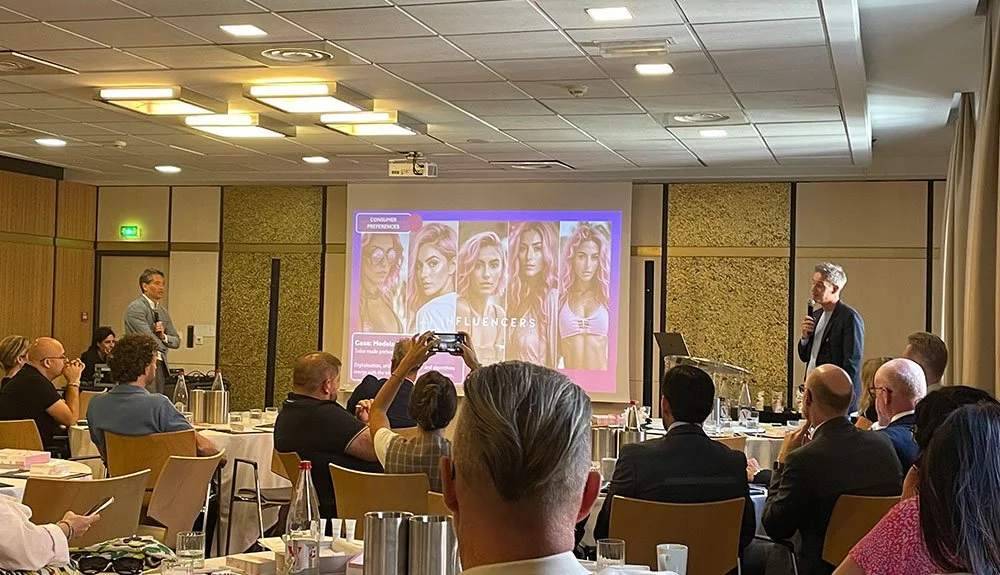
Thomas Kaneko Henningsen and Karl Walter – both Partners at Blueprint – presenttheir insights at the Cannes Gen Z workshop in 2025.
How does this tension between digital-first lives and the craving for real contact translate into what airports and brands actually build – and how does experience draw them into physical stores?
Anna Marchesini, Head of Business Development, m1nd-set: It comes down to redefining the relationship between the consumer and the physical space. For Gen Z consumers, experience is increasingly becoming part of the product proposition itself. Airports and brands can no longer rely solely on product assortment or promotional mechanics to drive conversion. Gen Z travellers increasingly view travel as an extension of their identity and are looking for experiences they cannot find elsewhere.
The winners will be those who replace transactional retail environments with destination-exclusive experiences, immersive storytelling, and digital interactions designed for speed, discovery, and participation. Our “Sensation Zeduction” masterclass is designed to provide the industry with practical, evidence-based insights into how to achieve exactly that.
From a brand perspective, how can tge challenge of connecting with younger, highly mobile travellers be approached?
Keigo Yamazaki, Director, LeSportsac, Inc.: For us, it is both a creative and a strategic priority. Gen Z continue to reshape how consumers discover, engage with and express themselves through brands like LeSportsac. We see travel retail as a unique environment to connect with younger travellers. We are looking forward to sharing and exchanging perspectives at the Sensation Zeduction masterclass, exploring new ways to create relevant shopping experiences, and connecting with our industry peers.
What is the commercial case for shifting to hybrid retail to seduce the Gen Z shoppers in the travel retail environment?
Karl Walter, Partner, Blueprint: The commercial case for understanding Gen Z has never been stronger, Faye. First of all, Gen Z spending power is forecast to reach a staggering US$12 trillion globally by 2030. Secondly, nearly two-thirds of consumers in this generation are increasing their spending on experiences rather than physical goods.
However, and this is the critical link for travel retail, 80% of Gen Z shoppers make their final purchase decisions in-store, making them the most influenceable demographic in the airport environment. They are also the generation that is most receptive to hybrid retail concepts that combine shopping, food, entertainment, and social interaction. For airports, retailers, and brands, this represents a major opportunity to rethink traditional commercial models and create environments that align with the expectations of tomorrow’s traveller.