
What will travel retail look like in 2030?
There’s no easy way to predict the future of travel retail, but forecasting remains an essential tool for building resilience in a rapidly changing world. We asked thought leaders on the topic to share their perspectives on how the sector is likely to evolve as we enter the next decade.
What will surprise people most about travel retail in 2030?
“The biggest surprise will be hyper-personalised AI assistants that proactively and dynamically adapt to individual traveller’s shopping behaviours factoring in budget, dwell time, availability, convenience and pricing transparency,” said Thomas Kaneko Henningsen, Partner, Blueprint, who pointed to global shoppers increasingly utilising AI for price checking and product enquiries.
“When these behaviours migrate to travel retail, travellers’ AI assistants will help plan shopping experiences before they arrive at the airport. It is highly likely that the level of impulse shopping will drop dramatically because of this,” he said.
“Parallel to this, airports will evolve into global media content platforms. By 2030, commercial success will depend as much on hyper-personal shopping experiences, social media content, storytelling and ecosystem partnerships as it does on transactional shopping.”
The latter point is one that Lennard Niemann, Managing Director Gharage Ventures, concurs with: “Everyone’s bracing for some AI concierge that magically anticipates their needs, but that’s not the surprise,” he said. “The surprise is how much of the growth will come from retail media: screens, content, brand activations woven into the store and the journey. People underestimate how big that line item becomes.”
No matter how advanced the technology is, the enduring value of human connection – and the ability to leverage the uniqueness of the travel retail environment to deliver it – may prove to be a key differentiator when it comes to securing a competitive edge.
“The speed at which emotional engagement replaces product availability as the primary competitive advantage,” Adrian Hayes, Founder & Independent Travel Retail Strategist, Cortex TR, told us. “We’ve spent decades optimising for what we sell. By 2030, the differentiation will be entirely about how passengers feel when they engage with it. The concept of Unreasonable Hospitality – genuine, human-to-human connection that goes beyond service – will emerge as the most powerful competitive advantage in travel retail. Unlike price, product range, or store size, it is almost impossible to copy when done right. Organisations that haven’t made this shift will find themselves at a significant disadvantage to those who do.”
Ultimately, the channel’s “unyielding resilience and adaptability” will see it through the next four years, asserted Aude Bourdier, Founder & CEO, AMB Futureproof.
“Critics have repeatedly predicted the sector’s demise, from the termination of intra-EU duty-free to the global pandemic, yet the industry has not only survived but thrived,” she reasoned. “By 2030, the most striking factor will be the sector’s proven ability to absorb geopolitical shocks and external disruptions, emerging stronger each time. The narrative of fragility will finally be replaced by a recognition of adaptability.”
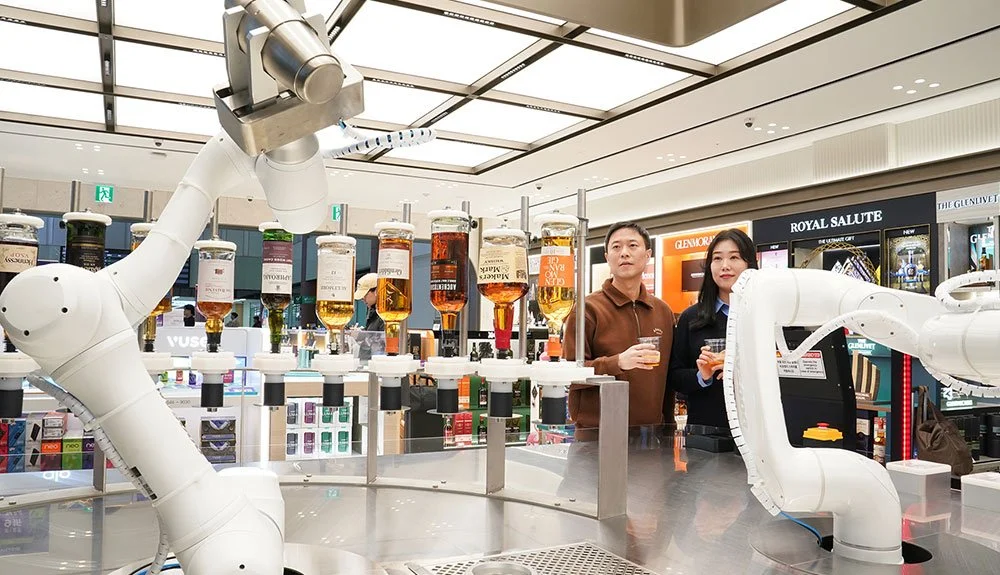
Robot bartenders in the Lotte Duty Free store at Gimpo International Airport.
What part of today’s travel retail model will no longer exist by 2030?
The rise of ecommerce is playing a role in making traditional retail built around transactional shopping feeling increasingly outdated, in the eyes of Henningsen. “The assumption that travellers will automatically shop because they are captive audiences is already breaking down,” he said. “As Gen Z becomes the largest customer profile by 2028 representing 1.2 billion travellers, according to m1nd-set, and with a NielsenIQ forecast showing a global spending power of $12 trillion by 2030 (the biggest ever by any generation), this mobile-first, AI-powered and social media-friendly global lifestyle will expect airports’ ecosystems to adapt to them, not the other way around; they will want to travel as they live. To future-proof this, airports, operators and brands will increasingly monetise unique shopping experiences, dwell time quality, data intelligence, social media content and omnichannel engagement.”
Key to cracking this will be breaking down silos.
“I’ve long believed that alignment across all parties – from airport to retailer to brand – is fundamental to unlocking real commercial performance,” said Hayes. “By 2030, the most successful operators will have moved beyond individual KPIs and organisational boundaries. Airports, retailers, and brands will team up with a single shared purpose – elevating the passenger journey. Right now we measure everything except whether the passenger feels valued and wants to engage more deeply in what we’re offering. That fragmented approach will be seen as commercially inefficient. The operators that thrive will be those that designed around passenger journeys, not organisational structures.”
The need for stakeholders being more symbiotic could, in fact, reach a tipping point.
“While abrupt obsolescence is unlikely in an evolutionary industry, the loss-making concession model is on borrowed time. This unsustainable framework creates a downward spiral: retailers operating at a deficit cannot invest in innovation or experience, ultimately failing the traveller. By 2030, we can hope that the market will have corrected this inefficiency. The era of accepting negative margins as a cost of entry will end, replaced by partnership models that prioritise mutual profitability and consumer value.”
Niemann, however brings the notion crashing back down to Earth with a bump. On the industry’s inner workings that may be resigned, he pointed out: “Honestly? Unfortunately, nothing. Let’s be realistic here. Most travel retail contracts run until 2030 or close to it, so structurally the model barely moves in that window.
“A revolution by 2030 is highly connected to the concession terms, and those cycles are moving too slow. What should change, and what I hope changes, is the assortment. It has to adjust to a new generation of consumers with completely different expectations, and the industry is heavily underestimating how fast that shift is coming. The contracts are locked. The customer isn’t.”