
Blueprint onboards Gen Z advisors to help DF&TR clients maximise relevance
Copenhagen-based consultancy Blueprint is deepening its efforts to bring the duty free and travel retail (DF&TR) industry actionable insights on appealing to Gen Z shoppers, by assembling a panel of consultants from the generation to advise on projects for clients.
“At Blueprint, we believe the best way to anticipate younger shoppers’ impact on travel retail is to invite them into the strategy room,” said Blueprint Partners Sonja Soskic, Karl Walter and Thomas Kaneko-Henningsen.
“Welcoming the next generation of thinkers is a dynamic way to future-proof our work by unlocking raw insight, cultural fluency and mobile-first instincts that challenge old assumptions and shape new perspectives. It is a breath of fresh air.”
The move underscores the influence of Gen Z and how they are expected to make their mark on the travel retail industry in the coming years.
According to m1nd-set research, there are 2.5 billion Gen Z globally – that’s 32% of the population.
Furthermore, Gen Z is expected to account for 1.2 billion global passengers flying in 2028, when they are on track to outnumber millennials as the largest global airline passenger group.
As the first generation raised entirely in a digital, on-demand world, however, their shopping habits and expectations are significantly different to the generations that came before them.
As m1nd-set research (reevaled at the 2025 TR Consumer Forum) shows, Gen Z visits duty-free stores more than older generations (44% of duty-free visitors out of total pax compared to 41% for others) yet converting them into buyers remains a challenge. Indeed Gen Z display a 65% conversion rate compared to 67% of others.
Crucially, online remains their primary source of information, with 19% utilising touchpoints such as a general internet search, or viewing content/ads on social media (13%).
Hence, targeting them effectively requires a distinctive approach, especially considering their wants and needs are also different to that of other generations.
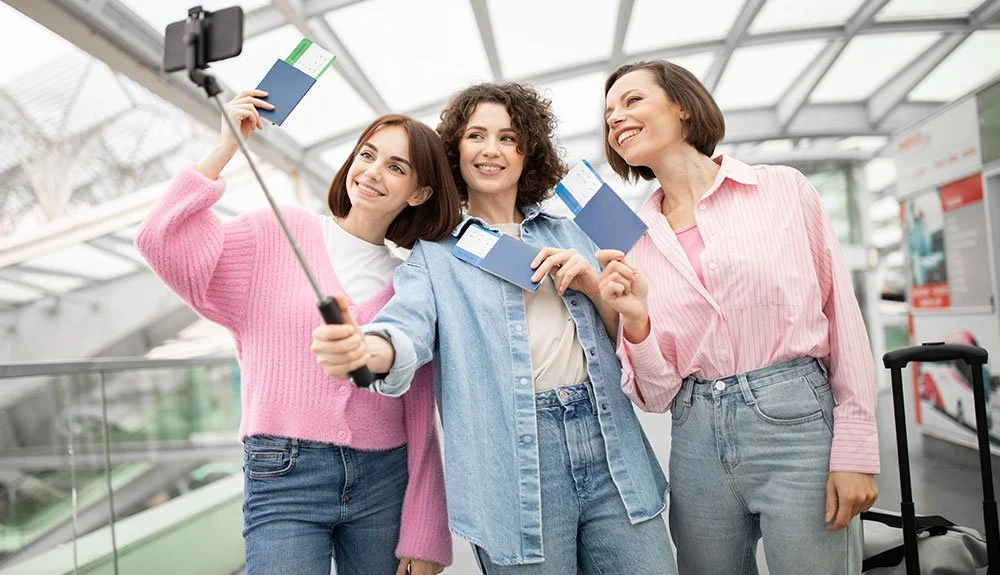
Online remains the primary source of information for Gen Z, says m1nd-set research. Photo: Shutterstock / Prostock-studio.
“This group of travellers don’t see airport shopping as a detour; it’s an extension of their identity and a platform for sharing experiences on social media,” explained Kaneko-Henningsen.
“From sustainability to social commerce, from hyper-personalisation to immersive brand spaces, Gen Z-friendly airports are content platforms that leverage unique experiences.
“That’s exactly why we give travel retail companies direct access to Gen Z thinkers who can vet initiatives targeting younger travellers.”
Blueprint’s speciality is highlighting how airports, operators and brands can excel at connecting with experience-hungry Gen Z lifestyle travellers.
The consultancy points to concepts in the channel that are already shining examples of this, such as Shelby &Co. Bar + Kitchen at Birmingham Airport (inspired by the popular Netflix show, Peaky Blinders); Au Vodka’s Guinness World Record breaking 250-litre bottle (an Instagram worthy moment in Stansted Airport) and Gate Garden at Varna Airport (a duplex terrace space allowing passengers to board their flights directly from a landscaped outdoor area).

Blueprint Gen Z panel members Afsara Mukith and Ana Savic.
“The Gen Z lifestyle is not just changing how travellers shop, they’re redefining why travellers shop. Their lifestyle is borderless, fast-moving and fuelled by culture, community and content,” said Afsara Mukith, a member of Blueprint’s Gen Z panel.
Added fellow Gen Z consultant Ana Savic:”As Gen Z thinkers we are excited about providing fresh, unfiltered insights and call-to-action that helps the travel retail community understand and appreciate younger travellers along with their values, behaviours and expectations.”
According to Blueprint, the travel retail marketplace ‘continues to undergo profound transformation fuelled by megatrends like artificial intelligence (AI), experiential retail, social commerce, geopolitics, health & wellness and sustainability’.
“At the heart of this transformation sits the Gen Z lifestyle travellers and their appetite for hyper-personalised, emotional and memorable shopping,” said Kaneko-Henningsen.
“Our new panel has, in part, been inspired by the Gen Z led conference session at the TR Consumer Forum in Amsterdam in June and the value of hearing directly from them – chiefly regarding what would inspire them to shop and spend more in the channel.
“We are looking forward to connecting more stakeholders into the industry directly to Gen Z consumers to help shape the way forward.”
10 ways airports are evolving to better target Gen Z shoppers
The coming five years, the Blueprint team predicts that airports will increasingly gravitate towards the following:
1.Reimagine the airport experience: Adapting terminal design, signage and digital journeys to improve engagement and flow.
2. Community-driven spaces: From experience-driven lounges to health and wellness zones, airports will design more places Gen Z wants to linger in, not just pass through.
3. Spot early cultural shifts: Employing Gen Z to a greater extent to help track emerging shopping behaviours and expectations, helping them to proactively adapt to upcoming trends.
4. Map the Gen Z purchase journey: Offering real-world insights on how younger travellers discover and buy from social media to in-terminal.
5. Test new shopping formats: From pop-ups to gamified checkouts and interactive storytelling, airports will draw upon Gen Z’s input to help build concepts that resonate.
6. Define value beyond price: Emotional relevance, ethical production and design-forward thinking matter more than markdowns and price advantage.
7. Communicate with cultural fluency: Using cultural insights to fine-tune campaigns, ensuring relevance and resonance throughout the airport.
8. Reinforce brand purpose: Amplifying stress-test messaging around sustainability, inclusivity and ethics to ensure authenticity.
9. Facilitate pre-travel browsing: Ensure airport shopping starts on social media platforms and continues in-store via smart AR glasses or AI-assisted apps.
10.Design for FOMO (Fear of Missing Out): Through limited-time exclusives, collectible collabs, live streaming, and airport-only editions.